
Sugar for jam is the refined white cane sugar that jam, jelly, marmalade and fruit preparation makers buy in bulk to set, sweeten and preserve their products. In a commercial jam it makes up a large share of the finished jar, because most standards require at least 60 to 65% soluble solids, and almost all of that comes from sugar. For most jams the right choice is a clean, low-colour grade such as ICUMSA 45, which keeps fruit colours bright and flavours true. We sell sugar for jam to fruit processors, food manufacturers and distributors worldwide, in 50 kg bags or 1 MT jumbo bags, shipped by container.
This guide is for jam factory owners, production managers, QA staff and buyers. It covers what sugar actually does in a jam, how much a recipe needs, which grade suits which product, why sugar quality shows up in the jar, how to store sugar in a fruit plant, and how to buy it at a fair delivered price. We link to official standards and technical guides where we use them. Where something is our own view as a sugar supplier, we say so.

Sugar for jam: what we sell
These are the grades jam and fruit processors buy from us. Each product page has the full specification sheet.
- Refined ICUMSA 45 sugar: 45 IU max, polarization 99.80% min, moisture 0.04% max, ash 0.04% max. The standard sugar for jam, jelly and marmalade.
- Refined sugar ICUMSA 35: 35 IU max, polarization 99.80% min, SO₂ 20 mg/kg max. For the clearest jellies and pale fruit products.
- Crystal white sugar: sparkling white, polarization 99.8% min, fine to medium crystal. Dissolves quickly in the kettle.
- Cane sugar ICUMSA 100: 100 IU max, polarization 99.8% min. For dark jams such as blackcurrant, plum or fig, and bakery fillings.
- ICUMSA 150 white sugar: 150 IU max. For cooked fruit fillings and dark fruit pastes where colour is hidden.
- Raw brown cane sugar Grade E: ICUMSA 600 to 1200. For chutneys, dark marmalades and specialty spreads where molasses flavour is wanted.
Packing: 50 kg PP bags with inner liner, 1 MT jumbo bags. Shipping: 20 ft containers, about 25 MT each. Terms: FOB or CIF your port. Ask for a jam sugar quote.
See the full range on our products page.
Why jam makers care so much about sugar
In most food products, sugar is one ingredient among many. In jam, it’s often the biggest one. A typical commercial jam is built from fruit, sugar, pectin and acid, and the sugar does more work than anything else in the jar.
That means two things for a buyer. First, sugar is one of your biggest costs, so the price per tonne matters. Second, any problem with the sugar shows up straight away in the product: a dull colour, a cloudy jelly, a jam that won’t set or one that crystallises on the shelf. Getting sugar for jam right is part of making good jam, not just a purchasing job.
What sugar does in jam
It preserves the fruit
High sugar levels make it hard for microbes to grow, because the sugar ties up the water they need. University of Missouri Extension puts it plainly: sugar helps keep jams and jellies safe by “preventing microorganisms from growing.” FAO’s fruit processing guide gives a rule of thumb of about 60% sugar as a preservation threshold.
It helps the jam set
Traditional jam gels because of three things working together: pectin, acid and sugar. Missouri Extension explains that sugar works with pectin, either commercial or naturally present in the fruit, to form a gel, and that the fruit’s natural acid is also needed. Take the sugar away, or cut it too far, and a standard high-methoxyl pectin jam won’t set properly. The same source warns against reducing sugar with regular pectin, and says low- or no-sugar pectin exists for lower-sugar products.
It adds flavour and holds colour
Sugar balances the acidity of the fruit and helps the jam keep its colour and flavour through cooking and storage. This is one reason low-colour, neutral-tasting white sugar is the norm: you want the fruit to be the flavour, not the sugar.
It gives body and texture
Sugar thickens the fruit mass and gives jam its spreadable body. Different sugar levels give very different textures, from a loose fruit spread to a firm, sliceable fruit paste.

How much sugar does jam need?
This depends on the standard you’re making to and the market you sell in. Here’s what the main references say.
EU standard
The EU directive on fruit jams, jellies and marmalades says that products covered by it must have “a soluble dry matter content of 60 % or more as determined by refractometer”, except where sugars are partly or wholly replaced by sweeteners. It also sets minimum fruit levels. For standard jam it’s 350 g of fruit per kg of product in most cases, and for “extra jam” it’s 450 g per kg. Marmalade needs at least 200 g of citrus fruit per kg.
US grade inspection
The USDA’s Agricultural Marketing Service uses a higher threshold for grading. Its inspection instructions state that jelly, jam and marmalade must reach 65% soluble solids, measured as degrees Brix on a refractometer.
FAO processing guide
FAO’s practical guide for fruit processors targets a finished Brix of about 68 for jam, with a check range of 68 to 70, and gives fruit-to-sugar ratios of 50:50, 45:55 and 40:60 for basic recipes.
In plain terms: for every tonne of finished full-sugar jam, somewhere around half a tonne or more is sugar, depending on the fruit and the recipe. That’s why jam makers are big sugar buyers, and why sugar for jam is worth buying well.
| Reference | Soluble solids | Notes |
|---|---|---|
| EU Directive 2001/113/EC | 60% or more | Min. fruit 350 g/kg for jam, 450 g/kg for extra jam |
| USDA AMS inspection | 65% | Jam, jelly and marmalade |
| FAO processing guide | Target 68 Brix | Check range 68 to 70 |
Always check the rules for your own market before setting a recipe. Many countries base their standards on the Codex Alimentarius standard for jams, jellies and marmalades, but national details vary.
Jam, jelly, marmalade and fruit spread: how the sugar job changes
These products look alike on a shop shelf, but the sugar for jam behaves a little differently in each.
Jam
Made from fruit pulp or purée. The fruit solids, seeds and skin hide small differences in sugar colour, so ICUMSA 45 is plenty for most. The main sugar concerns are reaching the target Brix and avoiding crystallisation.
Jelly
Made from fruit juice or extract, so it’s clear. This is the most demanding product for sugar colour and cleanliness. Any haze, speck or tint shows. ICUMSA 35 or a low-reading ICUMSA 45 is the safe choice. The EU directive sets the same minimum fruit content for jelly as for jam, with the water used for extraction left out of the calculation.
Marmalade
Made from citrus, usually with peel. Under the EU directive it needs at least 200 g of citrus fruit per kg, and FAO’s guide says marmalade soluble solids should be not below 65%. Clear, bright marmalade with translucent peel needs low-colour sugar. Dark, thick-cut marmalades sometimes include brown sugar on purpose.
Fruit spreads and reduced-sugar products
Products sold as fruit spreads, or labelled reduced sugar, often fall outside the formal jam definitions because they have less than the standard soluble solids. They still use sugar, just less of it per jar, and usually rely on low-methoxyl pectin. Check your local rules on what can be called “jam”.
Fruit paste
Firm, sliceable products such as guava or quince paste. These are cooked to high solids and set firm. Sugar quality matters for colour and clarity in lighter pastes.
Reduced-sugar jams and what they mean for buying sugar
Many markets are pushing for lower-sugar foods, and jam is no exception. Some jam makers are adding reduced-sugar or fruit-spread lines alongside their classic recipes. What does that mean for your sugar buying?
- Less sugar per jar, not zero. Most reduced-sugar products still use a good amount of sugar for jam. Your total volume may fall a little, but you’ll still be a significant buyer.
- Different pectin. Missouri Extension warns not to cut sugar with regular pectin. Reduced-sugar lines need low- or no-sugar pectin and a recipe built for it.
- Shelf life changes. Less sugar means less natural preservation, so products may need refrigeration after opening, tighter hygiene, or permitted preservatives.
- Sugar quality matters more, not less. With less sugar in the recipe, flavour and colour depend more on the fruit and the cleanliness of every ingredient.
For most jam makers, full-sugar products remain the bulk of the business. A steady supply of well-specified sugar for jam still underpins everything else.
The sucrose limit and why jam crystallises
Here’s a detail that matters a lot in practice. Sucrose on its own can only stay dissolved up to a point. FAO’s guide gives the maximum sucrose in the liquid phase as about 67.89%. Above that, sucrose tends to crystallise out, which shows up as gritty crystals in the jam.
So how do jams reach 68 to 70% soluble solids without crystallising? During boiling with fruit acid, part of the sucrose breaks down into glucose and fructose, called invert sugar. A mix of sucrose and invert sugar can stay dissolved at a higher total concentration than sucrose alone. FAO notes that totals of 70 to 72% are possible because inversion increases the solubility of the sugars.
This is why boiling time, acid level and sugar quality all interact. Too little inversion and the jam may crystallise. Too much and it can become runny or sticky. A consistent, high-purity sugar for jam makes this balance easier to repeat batch after batch, because you’re starting from the same point every time.

Pectin, acid and sugar: getting the balance right
Most commercial jams use high-methoxyl pectin, which needs high sugar and the right acidity to set. FAO’s guide says pectin gels at pH 3.2 to 3.4, with batch checks aimed at pH 3.2 plus or minus 0.2.
One practical tip from the same guide is worth passing on: pectin powder should be pre-mixed with about 5 to 10 times its weight in sugar before it goes into the kettle. That stops the pectin forming lumps. It also means a little of your sugar for jam is doing double duty as a carrier for the pectin.
FAO also gives a useful troubleshooting hint. If liquid forms on the surface of the set jam, the pH is too low, so reduce the acid. If the jam won’t set at all, the soluble solids or pH are probably too high.
For low-sugar jams, the picture changes. These usually use low-methoxyl pectin, which sets with calcium rather than high sugar. They need less sugar for jam per jar, but also have less preservation from sugar, so they often rely on other measures such as stricter hygiene, preservatives where allowed, or refrigeration after opening.
Which grade of sugar for jam suits which product
Here’s how we’d match grades to products. Your own recipes and customers have the final say.
| Product | Suggested grade | Why |
|---|---|---|
| Clear fruit jellies (apple, quince, redcurrant) | ICUMSA 35 or 45 | Clarity and bright colour |
| Strawberry, raspberry, apricot jam | ICUMSA 45 | Keeps red and orange tones bright |
| Citrus marmalade | ICUMSA 45 | Translucent peel and clear gel |
| Blackcurrant, plum, fig, dark berry jams | ICUMSA 45 or 100 | Dark colour hides small differences |
| Bakery jam and fruit fillings | ICUMSA 100 or 150 | Hidden inside baked goods |
| Fruit preparations for yogurt | ICUMSA 45 | Colour shows through white yogurt |
| Fruit pastes (guava, quince paste) | ICUMSA 45 or 100 | Depends on fruit colour |
| Chutney, dark marmalade, specialty spreads | Raw brown Grade E, often blended | Molasses flavour wanted |
A note on brown sugar: Missouri Extension notes that brown sugar and molasses are generally not recommended for fruit preserves because their stronger flavours can overpower the fruit. That’s true for most jams. Brown sugar earns its place in chutneys and some dark, bitter marmalades, where the extra depth is the point. See our bulk brown sugar guide for those uses.
For more on how the colour scale works, see our ICUMSA scale guide. Our posts on food grade ICUMSA 45 sugar, ICUMSA 35 sugar, ICUMSA 100 sugar and ICUMSA 150 sugar go into each grade.

The spec sheet numbers to check on sugar for jam
| Parameter | Typical for ICUMSA 45 | Why a jam maker cares |
|---|---|---|
| Colour (ICUMSA) | 45 IU max | Brightness of fruit colour, clarity of jellies |
| Polarization | 99.80% min | Sucrose purity; predictable Brix |
| Moisture | 0.04% max | Accurate weighing, no caking |
| Ash | 0.04% max | Lower minerals, cleaner gel |
| SO₂ | 20 mg/kg max | Allergen labelling in some markets |
| Insoluble matter | None visible | Specks in clear jellies |
| Granulation | Fine to medium | Fast dissolving; good pectin premix |
Colour and clarity
Colour in the sugar adds to colour in the jam, and long boiling adds more. For pale and clear products, start with the lowest-colour sugar for jam you can justify. Our ICUMSA 45 specification guide explains how colour is measured.
Sulphur dioxide
Some refined sugars carry traces of sulphur dioxide from processing. In the EU and UK, labelling law treats sulphur dioxide and sulphites above 10 mg/kg in the product as eaten as an allergen. Jam can be more than half sugar, so it’s worth doing the maths for your recipe, especially if your fruit has also been preserved with sulphites. Ask us for the actual SO₂ reading on the certificate.
Granulation
Fine to medium crystals dissolve quickly in the kettle and mix evenly with pectin powder. Very coarse sugar can leave undissolved crystals, which may seed crystallisation later.
Our bulk refined sugar guide covers the full list of parameters.
Common jam problems where sugar for jam plays a part
Gritty or crystallised jam
Usually too much sucrose and not enough inversion, often from a short boil or low acid. Undissolved sugar crystals can also start crystallisation, so make sure the sugar is fully dissolved before boiling hard.
Jam that won’t set
Usually the wrong balance of pectin, acid and sugar, or a soluble solids level below target. Check your refractometer readings and pH. FAO’s guide suggests that if a jam won’t set, soluble solids or pH may be too high.
Weeping or syneresis
Liquid on the surface often means the pH is too low, according to the FAO guide. Reduce the acid.
Dull or brown colour
Overcooking, holding the batch hot too long, or a higher-colour sugar than usual. Compare the ICUMSA reading on the certificate with earlier lots.
Mould on the surface
Usually low soluble solids, poor hygiene at filling, or a bad seal. Sugar at the right level helps preserve the jam, but it can’t fix a dirty filling line.
Specks in clear jelly
Foreign matter in the sugar or fruit, or scorched residue on the kettle. Keep retained samples of each sugar lot so you can rule the sugar in or out quickly.

Sugar for jam by type of business
Industrial jam factories
Large plants often cook under vacuum at lower temperatures to protect colour and flavour, and dissolve sugar into syrup before adding fruit. They usually buy ICUMSA 45 by the container on a schedule, often in jumbo bags feeding a dissolving station.
Small and medium jam makers
Open kettle cooking in smaller batches. 50 kg bags are easier to handle. Many use one grade, usually ICUMSA 45, across all products.
Fruit preparation makers
Fruit preparations for yogurt, ice cream and bakery are close cousins of jam. The Tetra Pak dairy handbook notes that sweet fruit additives for yogurt normally have a sugar content of 50 to 55%. These plants buy sugar for jam-style products in large volumes. Our sugar for dairy guide covers the dairy side.
Bakery filling producers
Bake-stable fillings for pastries, biscuits and cakes. Colour matters less, so ICUMSA 100 or 150 often works. See our bakery sugar guide.
Fruit paste and candied fruit producers
Guava paste, quince paste and candied peel use very high sugar levels. They overlap with confectionery, covered in our sugar for confectionery guide.
Farm and cooperative processors
Fruit growers and cooperatives that turn surplus fruit into jam during harvest season. They often need a lot of sugar for jam in a short window, so planning ahead is essential.

Planning sugar for jam around the fruit season
Jam production follows the fruit. Strawberries, apricots, citrus, berries and stone fruit all have short peaks, and that’s when your sugar use spikes. Many jam makers process fresh fruit at harvest and frozen or aseptic pulp the rest of the year, but the fresh-fruit weeks are usually the busiest.
A few habits help:
- Work backwards from harvest. Sea freight, clearance and trucking can take several weeks door to door. Have sugar in your store before the first fruit arrives.
- Agree a schedule. Spread shipments over the months before and during your peak. You get steadier prices and less risk if one ship runs late.
- Keep a safety stock. Fresh fruit won’t wait for a delayed container. A couple of weeks of sugar for jam on hand protects your harvest.
- Don’t switch grades mid-season. Keep the sugar the same through the busy weeks so any problems are easier to trace.
Tell us your fruit seasons when you ask for a quote, and we’ll suggest a shipment schedule to match.
Storing sugar for jam in a fruit plant
Fruit processing plants are wet and warm: washing lines, steaming kettles, hot filling, frequent wash-downs. All of that is bad for stored sugar.
Research by Mathlouthi and Rogé, presented to the South African Sugar Technologists’ Association, found that white sugar cakes mainly because moisture moves in and out of the crystal surface as humidity and temperature change. Lumpy sugar doesn’t weigh accurately and dissolves slowly, which throws off your Brix.
What helps:
- Keep sugar for jam in a separate dry store, away from washing areas and kettles.
- Avoid big temperature swings in the store.
- Stack bags on pallets, off the floor and away from walls.
- Don’t store sugar near fruit cold rooms, where condensation is likely.
- Use stock first in, first out, and keep lot numbers on every pallet.
- Control pests. Sugar and fruit together attract insects and rodents.
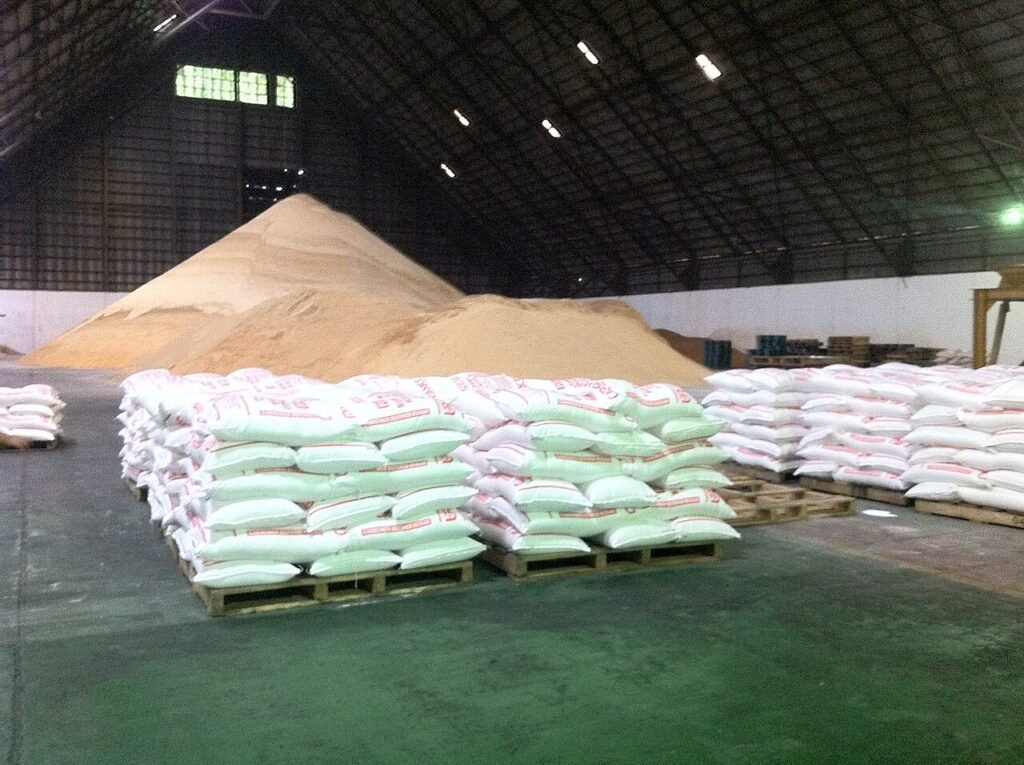
Bags, jumbo bags or syrup: receiving sugar for jam
50 kg bags
The standard for small and medium plants. Easy to count and store, and easy to weigh into batches by hand.
1 MT jumbo bags
For plants with a hoist and a discharge station feeding a dissolver or a batching system. Less handling and less packaging waste.
Dissolving in-house
Many larger plants dissolve granulated sugar into a syrup before adding fruit. It speeds up cooking and makes dosing easier. Buying granulated sugar and dissolving it yourself is usually cheaper than buying liquid sugar, because you aren’t paying to ship water.
A worked example: sugar for jam costs
A made-up plant to show the method. The numbers are only examples.
Say a factory working with a 45:55 fruit-to-sugar recipe uses about 55 tonnes of sugar for jam a month. Over a year, that’s about 660 tonnes, or more than 25 containers.
At that volume, a difference of US$20 a tonne in delivered price is worth over US$13,000 a year. That’s why it pays to compare suppliers on a delivered basis, plan shipments to avoid rush freight, and keep the grade consistent so you aren’t paying for rejected batches.
Now suppose 30% of that sugar goes into bakery fillings. Moving that line to ICUMSA 150, if it lands at, say, US$30 a tonne below ICUMSA 45, would save roughly another US$5,900 a year. Whether that’s worth two stock lines is your call.
What sugar for jam really costs
To compare offers properly, build up the delivered cost: sugar price, ocean freight, insurance, import duty, port and clearing fees, and transport to your plant. Duty on refined sugar can be high in some countries and may matter more than small price differences.
Refined sugar prices follow the ICE White Sugar futures contract in London. Many jam makers fix prices for several months ahead of their season so they can set their own selling prices with confidence.
The wider market matters too. In its May 2026 Sugar: World Markets and Trade report, the USDA forecasts world sugar production for 2026/27 at about 184.9 million tonnes, with Brazil producing slightly less as more cane goes to ethanol. That isn’t a shortage, but prices can move. Our posts on sugar wholesale prices, sugar import prices and the sugar HS code explain the cost lines.
Checklist before you sign a contract for sugar for jam
- Grade named, with maximum ICUMSA colour.
- Polarization, moisture and ash limits in writing.
- SO₂ limit stated, if your market has sulphite labelling rules.
- Granulation described.
- Packing agreed: bag type, liner, marking and pallets.
- Independent inspection at loading, with the certificate in the document set.
- Food safety certificates from the producing mill.
- Certificate of origin, plus halal or kosher certificates if your markets need them.
- A delivery schedule that covers your fruit season.
- Secure payment terms, such as a letter of credit for a first order.
Our page on the certificate of origin explains that document, and our guide to which certifications prove food grade covers the rest.
7 tips for buying sugar for jam
1. Start with ICUMSA 45
It suits almost every jam, jelly and marmalade. Only move to other grades where you can see a real saving and the colour won’t show.
2. Ask for actual readings
The spec says “45 IU max”. The certificate says what this lot measured. For clear jellies, that number matters.
3. Keep the sugar consistent
Your Brix, inversion and set all depend on starting from the same sugar. Changing supplier or grade mid-season makes problems harder to trace.
4. Trial before you switch
Run new sugar through your most sensitive product, usually a clear jelly or bright strawberry jam, and compare side by side.
5. Plan around harvest
Get sugar for jam into your store before the fruit arrives, not after.
6. Store it dry
Caked sugar costs you time and accuracy. Keep it away from steam and wash-down areas.
7. Check your supplier
Ask where the sugar comes from, which mill, which port and who inspects it. Our guides on checking a sugar exporter before you pay and how to spot a real sugar trader list the warning signs.
Where our sugar comes from and how it ships
We source refined white and raw brown cane sugar mainly from Brazil and Thailand, two of the world’s largest sugar exporters according to the USDA. Our guides to Brazilian sugar, Thai sugar and Indian sugar explain what each origin offers.
Sugar for jam ships in clean, dry 20 ft containers, lined and fitted with desiccant. Our post on what a sugar logistics supplier handles covers loading and arrival checks, and our shipping policy sets out the terms. If you resell sugar to smaller jam makers, our sugar distributor guide is written for you.
How to order sugar for jam from us
- Tell us what you make. Products, monthly volume, fruit seasons, current sugar grade, port and bag size. Use our contact form.
- Get a recommendation and quote. We’ll suggest a grade and quote FOB or CIF with the full spec sheet.
- Trial if needed. Run the sugar through your most demanding product first.
- Agree the contract. Grade, limits, packing, inspection, documents and payment in writing.
- Loading and inspection. Each lot is inspected at loading and the certificate goes with the documents.
- Regular supply. Set up a schedule around your fruit seasons.
Our FAQ page answers common questions, and our guide to buying sugar in bulk covers the basics for first-time importers. For other food uses, see our industrial sugar and wholesale food sugar guides.
Frequently asked questions about sugar for jam
What is the best sugar for jam?
For most commercial jams, jellies and marmalades, refined ICUMSA 45 white cane sugar. It’s very pure, dissolves cleanly and keeps fruit colours bright. ICUMSA 35 suits the clearest jellies; ICUMSA 100 or 150 can work for dark jams and bakery fillings.
How much sugar is in jam?
Full-sugar jams usually reach at least 60 to 65% soluble solids, most of it sugar. FAO’s processing guide uses fruit-to-sugar ratios of 50:50, 45:55 and 40:60.
Why does jam need so much sugar?
Sugar preserves the jam by limiting microbial growth, helps pectin form a gel, and gives body and flavour.
Why does jam crystallise?
Sucrose can only stay dissolved up to about 68% on its own. If there isn’t enough invert sugar from boiling with acid, sucrose can crystallise out.
Can I use brown sugar for jam?
It’s usually avoided because its flavour can overpower the fruit, but it works in chutneys and some dark marmalades.
What is the difference between jam sugar and sugar for jam?
In some markets “jam sugar” means retail sugar with added pectin. Sugar for jam in this guide means plain refined sugar bought in bulk by manufacturers, who add their own pectin.
Does sugar for jam contain sulphites?
Some refined sugars contain traces of SO₂. ICUMSA 45 is typically 20 mg/kg max. Check your labelling rules and recipe.
How should sugar for jam be stored?
Dry, at steady temperature, on pallets, away from steam, wash-down areas and cold rooms.
What is the minimum order?
Usually one 20 ft container, about 25 tonnes.
Do you ship sugar for jam worldwide?
Yes, to ports across Asia, Africa, Europe, the Middle East, the Americas and Oceania. Ask for a quote.
Key takeaways
- Sugar for jam is usually refined ICUMSA 45 white cane sugar, with ICUMSA 35 for clear jellies and ICUMSA 100 or 150 for dark jams and fillings.
- Sugar preserves jam, helps pectin set and gives body and flavour.
- Standards typically require 60 to 65% soluble solids; FAO targets about 68 Brix.
- Sucrose alone crystallises above about 68%, so inversion during boiling matters.
- Check colour, polarization, moisture, SO₂ and granulation on every lot.
- Plan sugar deliveries around your fruit seasons and compare suppliers on delivered cost.
Ready to buy? Request a sugar for jam quote or see our full product range. Our guides to bulk white sugar and bulk granulated sugar are also worth a look.
Sources and References
- Council Directive 2001/113/EC relating to fruit jams, jellies and marmalades, Annex I
- USDA Agricultural Marketing Service: soluble solids inspection instructions for jams, jellies and marmalades
- FAO: Fruit and vegetable processing, fruit sugar preserves technology
- University of Missouri Extension: Preserve It Fresh, Preserve It Safe (HES146)
- Tetra Pak Dairy Processing Handbook: Fermented milk products
- Regulation (EU) No 1169/2011, Annex II: substances causing allergies or intolerances
- Mathlouthi and Rogé: Caking of white sugar and how to prevent it (Proc. S. Afr. Sug. Technol. Ass., 2004)
- ICE: White Sugar Futures contract specifications
- USDA Foreign Agricultural Service: Sugar: World Markets and Trade (May 2026)
Photo credits: Colorado State University Extension (CC0); Nutrition, Food Safety and Health (CC0); Baryonic Being (CC BY-SA 3.0); Tehmina Goskar (CC BY-SA 4.0); Rita (CC0); Markadan (CC BY-SA 3.0); all via Wikimedia Commons.