
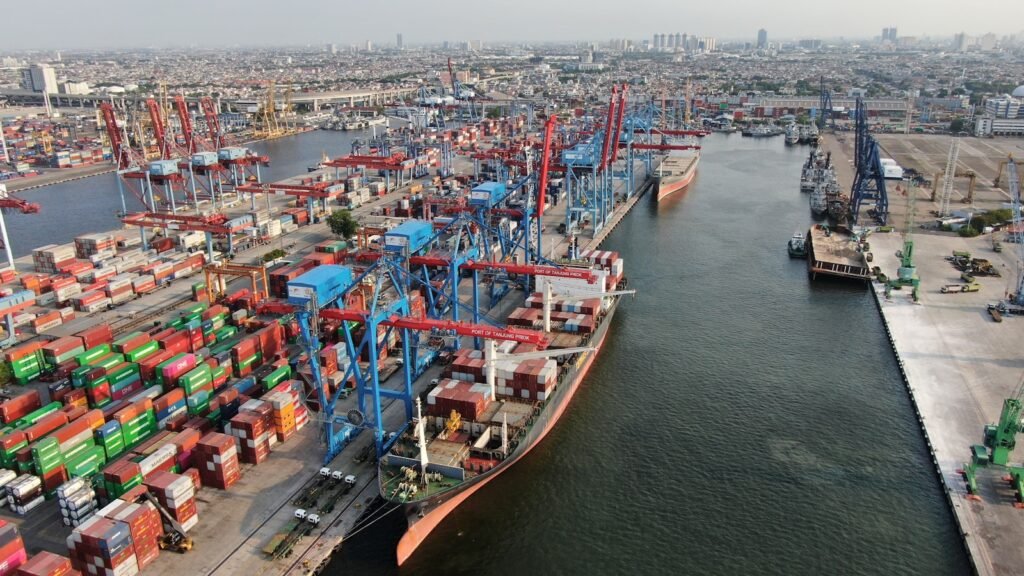
An ICUMSA 45 sugar exporter does more than quote a price and wait for a wire transfer — the job is moving real cargo through real ports, with documentation that holds up at customs on the other end. Global Sugar Supplies exports ICUMSA 45 white refined sugar out of Brazil to buyers across Africa, the Middle East, and Asia, and this page walks through how that export process actually works, port by port and document by document.
What an Exporter Does That a Broker Doesn’t
There’s a meaningful difference between an exporter and a broker, and it’s worth understanding before you commit to a contract. A broker takes your inquiry, shops it around to find a mill willing to fill it, and inserts a margin in between — often without ever touching the product or the shipping process directly. An ICUMSA 45 sugar exporter, by contrast, controls the chain from mill output through to vessel loading: booking the freight, arranging inspection, preparing the documentation, and standing behind the cargo if something goes wrong at any stage. We operate as the latter. When you’re moving thousand-ton volumes, that distinction shows up the moment a shipment hits a snag — a broker disappears, an exporter fixes it.
The Export Process, Step by Step
Here’s what actually happens between your inquiry and cargo arriving at your port:
- Inquiry and offer: you send quantity, packing, destination, and payment terms; we respond with a formal offer within 24–48 hours.
- Contract: once terms are agreed, we sign a standard sale and purchase agreement covering spec, quantity, price, and delivery window.
- Production and packing: the mill processes and bags to your specification, typically 10–15 days for standard volumes.
- Pre-shipment inspection: SGS or Intertek samples the batch at loading and issues a certificate confirming the contracted spec.
- Loading and documentation: Bill of Lading, Commercial Invoice, Packing List, Certificate of Origin, Phytosanitary Certificate, and the inspection report are issued, typically within 5 business days of loading.
- Ocean transit: vessel sails to your destination port, with transit time depending on the route.
- Arrival and customs clearance: your customs broker clears the cargo using the document set we’ve provided.
Ports and Shipping Methods
We load primarily from Santos and Paranaguá in Brazil — Santos specifically is the largest sugar export terminal in the world by volume, which means deep experience handling bulk and bagged sugar cargo without the delays smaller terminals sometimes run into. As an ICUMSA 45 sugar exporter we work both container and bulk vessel logistics: container loads for the 20–500 MT range (a 20ft container holds roughly 24 MT in 50kg bags, a 40ft around 26 MT), and chartered bulk or breakbulk vessels for larger parcels from 5,000 MT upward. Destination can be effectively any port in the world with sugar import infrastructure — we’ve shipped into West African, East African, Middle Eastern, South Asian, and Southeast Asian ports regularly.
ICUMSA 45 Specification Recap
For reference, the product we export under the ICUMSA 45 label carries: ICUMSA color 45 RBU maximum, polarization 99.80° minimum, moisture 0.04% maximum, ash 0.04% maximum, reducing sugars 0.05% maximum, and SO2 at 2 ppm maximum. For the full breakdown including packaging, MOQ, and certifications, see our dedicated ICUMSA 45 Sugar Supplier page.
Export Documentation, in Plain Terms
Every shipment we export carries a full document set, and it’s worth knowing what each one actually does. The Bill of Lading is your title to the goods and what your bank needs to release payment under a Letter of Credit. The Certificate of Origin, issued by the Brazilian Chamber of Commerce, confirms where the sugar was actually produced — required for preferential tariff treatment in many markets. The Phytosanitary Certificate confirms the cargo is free of plant pests, a standard requirement for agricultural imports almost everywhere. The SGS or Intertek inspection report is the independent confirmation that what’s in the bags matches the contract spec. HALAL and KOSHER certificates ship on request for buyers whose destination market requires them. Missing or incorrect documentation is the single most common cause of customs delays, which is why we treat this part of the process as seriously as the product itself.
Payment and Pricing
As an ICUMSA 45 sugar exporter operating in physical commodity trade, we quote against the ICE Liffe No. 5 white sugar futures contract plus a basis reflecting grade, origin, and incoterm. Standard payment is an irrevocable Letter of Credit at sight from a prime bank for new buyers, with TT against documents available once there’s an established trading relationship. We quote FOB, CFR, and CIF depending on whether you’re handling your own freight or want it included.
Lead Times by Region
Realistic transit windows from Santos: West Africa roughly 18–25 days, East Africa 25–32 days, Middle East and Gulf ports 25–35 days, South Asia 30–38 days, Southeast Asia 32–42 days. Add the 10–15 day production and loading window ahead of sailing, and most buyers should plan on 45–75 days total from signed contract to cargo on the ground, with port congestion at either end being the main variable.
What to Watch Out For
The export side of the sugar trade attracts a disproportionate number of fraudulent operators because the transaction sizes are large and the buyers are often unfamiliar with how legitimate commodity trade actually runs. A genuine ICUMSA 45 sugar exporter doesn’t ask for advance fees before issuing a real offer, doesn’t insist on NCNDA/IMFPA paperwork as a precondition to talking, and doesn’t pressure you to sign within 24 hours on a multi-million-dollar transaction. If a “supplier” is offering ICUMSA 45 at a price meaningfully below the ICE No. 5 benchmark, that’s a signal to ask harder questions, not a reason to move faster.
Frequently Asked Questions
Can you export to a port you haven’t shipped to before? Generally yes — we work with established freight forwarders who can route to most ports with sugar import handling capability.
Do you handle customs clearance at destination? No, that’s typically the buyer’s customs broker, but we provide the full document set needed for clean clearance.
What happens if an inspection fails? The cargo doesn’t load until it passes — we don’t ship off-spec product and ask buyers to sort it out after the fact.
Request a Quote
Send us your destination port, quantity, packing preference, and payment terms, and we’ll come back with a formal export offer within 24–48 hours. For the full product specification, visit our ICUMSA 45 Sugar Supplier page; for buying process details see Buy ICUMSA 45 Sugar; for bulk and wholesale pricing breaks see Wholesale ICUMSA 45 Sugar and Bulk ICUMSA 45 Sugar. You can also see our broader export range on the Sugar for Sale page.
For background on international food safety standards that apply to sugar exports, see the Codex Alimentarius standards published jointly by the FAO and WHO.
Why Brazil Dominates ICUMSA 45 Export Volume
If you look at where most of the world’s traded ICUMSA 45 actually comes from, Brazil accounts for a disproportionate share — somewhere around 40% of global sugar exports in a typical year. That’s not an accident of geography so much as decades of investment in mechanized harvesting, large-scale mill infrastructure, and port capacity built specifically around moving bulk agricultural commodities efficiently. As an ICUMSA 45 sugar exporter working out of the center-south region, we’re tapping into that existing infrastructure rather than trying to build export capability from scratch, which is part of why lead times stay relatively predictable even during periods when global freight markets are tight.
Container vs Bulk Vessel — Which Makes Sense for Your Order
This question comes up constantly, and the honest answer is it depends almost entirely on your volume and your receiving infrastructure. Container shipments make sense below roughly 500 MT — you get flexibility on timing, smaller deposit exposure, and you don’t need silo or bulk handling equipment at destination. Above that, the per-ton freight cost of containers starts to look expensive compared to a chartered vessel, but a chartered vessel only makes financial sense if you can actually receive 5,000+ MT in one go, which usually means either silo storage or a fast bagging operation at the port. A lot of our mid-size buyers end up doing breakbulk parcel shipments in the 1,000–5,000 MT range as a middle ground — sharing vessel space with other cargo rather than chartering a full ship, which keeps costs down without requiring container-level flexibility.
What Happens If Your Shipment Is Delayed
Port congestion happens, and any exporter who tells you it never will is not being straight with you. What matters is how it’s handled when it does. We track vessel scheduling and port conditions at both Santos and Paranaguá continuously, and we communicate delays as soon as we know about them rather than letting a buyer find out when a vessel doesn’t show up on the expected date. If a delay is going to materially affect your downstream production schedule, we’ll work with you on options — splitting a shipment, adjusting the loading port, or in some cases expediting through a different vessel slot if one’s available. This is part of what separates an actual ICUMSA 45 sugar exporter handling the logistics directly from a broker who’s just relaying information from someone else further up the chain.
A Realistic Look at First-Time Buyer Concerns
If this is your first time importing ICUMSA 45 sugar at commercial scale, the questions you should be asking are different from the ones a repeat buyer asks. New buyers tend to focus heavily on price; experienced buyers focus on documentation accuracy, inspection rigor, and whether the exporter answers questions directly instead of deflecting. Ask to see a sample SGS report from a recent shipment. Ask who the named mill or refinery is — a legitimate exporter will tell you. Ask what happens contractually if an inspection comes back off-spec. The answers to those three questions will tell you more about whether you’re dealing with a real ICUMSA 45 sugar exporter than any price quote will.
Insurance and Cargo Protection
On CIF and CFR terms, marine cargo insurance is arranged as part of the shipment and covers the standard risks of ocean transit — loss, damage from heavy weather, contamination from seawater ingress if a container is compromised. On FOB terms, that responsibility shifts to the buyer once cargo is loaded, so if you’re buying FOB and don’t already have a marine insurance policy in place through your own freight forwarder, it’s worth arranging before the vessel sails rather than after. We can recommend insurers we’ve worked with before if you need a starting point.
Sample Shipments Before Committing to Volume
We understand that 1,000 MT is a meaningful commitment for a buyer who hasn’t worked with us before, especially if you’re comparing multiple potential suppliers at once. While we can’t offer retail-size samples for ICUMSA 45 given the production economics, we can arrange for an independent inspector of your choosing to review a recent shipment’s full SGS documentation and, where logistically possible, a small physical sample pulled from current production before you commit to a full contract. It’s not the same as a free trial, but it gives you something concrete to evaluate rather than just our word.
Get Your Export Quote
If you’re ready to move forward, send us your destination port, required quantity, packing format, and preferred payment terms, and we’ll have a formal offer back to you within 24 to 48 hours, including the full specification sheet and a realistic delivery timeline for your specific route.